Tuesday, October 19, 2010

Those Pesky Leopards/Humans

I'm living pretty close to the woods in the hills along the edge of the valley. It is really great, in fact, the mountain air and the rural setting. I wonder about what lies in the woods, though. One of my favorite stories from studying at Pitzer College Nepal in 2008 was the week I taught English in a small secondary school in Balkot and a leopard wandered into one of the schoolteachers' houses:

Don't make that face. He was tranquilized. (2008)

There was a giant crowd and the police had helpfully put up a cordon of red tape. The media was there, and the zoo came and carted the leopard away. I made a brief, completely unintelligible video of it. Anyway, I was talking to the father at my Boharatar residence about this incident and he said that he remembered when that happened. I was surprised that it was such big news in the valley. But according to an article from the Nepali Times, this is happening more and more often:


Leopards rarely attack people when unprovoked. But, unfortunately, there have been more recent incidents in Balkot that ended more tragically for the leopard.

Saturday, October 16, 2010

Short Film of Indra Jatra

I hereby present the first of hopefully many short films I will create based on topics of my own interest in Kathmandu Valley:

Indra Jatra 2010

This is the culmination of a tiny bit of camera work, a tiny bit of computer editing, and a whole lot of waiting around in a cafe in Lazimpat while the video uploads. Where I live now I have to ride a bus for an hour to find Internet access fast enough to just play a youtube video, to say nothing of uploading one.

And speaking of Indra Jatra, seeing as how we're in constant danger of fetishizing the Other around here, I thought I would post this article from a Nepali blog that I might have to start reading, brought to my attention by a fellow Fulbrighter:

How to Write About Nepal

I like it. My reaction to the article was a pretty even mix of "That's right on!" and "Crap, am I doing that?"

Wednesday, October 13, 2010

Indra Jatra 2010: In Which I Was Not Trampled by Elephants Nor Communists

I recently posted about the mythology of Indra Jatra. The subject is close to my heart because of my experience with Indra Jatra back in 2008.

Indra Jatra back in 2008.

Back then, the monarchy had just been abolished. For the first time in this age the Kumari did not officially bless the former King (although she did unofficially - the first year that the former King did not even attend was this year). Instead, she gave a blessing to the newly elected Prime Minister (the head of the government) and the President (the head of state, whose duties are most often ceremonial and religious).

Taken in 2008

At the time I had only a vague notion of what was going on around me. To avoid a crowd at the entrance to Durbar Square I had walked through a back alley, but it was so crowded that I got stuck. Suddenly, I heard cymbals behind me and a rush of people and I was pushed through the crowd and knocked over right in front of the chariot of the Kumari. There were police and people pulling the cart and other people fighting in the alley where I was standing. I thought they were communists because they wore only green and had military-style hats (I still don't know who they were). There was a giant red demon twirling back and forth and occasionally lashed out at people. Then the chariot started moving forward. It all seemed pretty dangerous, and I didn't know what to do, so I watched my back and [recorded a video of it].


I was also the only one of my friends to get a glimpse of the Kumari (taken in 2008).

It seemed calmer as I walked out of the back alleys and into the crowded open space of Durbar Square. Then, suddenly, a bunch of people ran the opposite direction and I saw that they were being chased by a giant three-eyed elephant. I had to dodge and run away.


I snapped this picture over my should as I fled in confused terror. (taken in 2008)
This year I was much more prepared. My Nepali teacher is Newari, and she has lived in the area around Durbar Square that is steeped in these ancient traditions. I spent my Nepali classes asking her as many questions as I could, and she even took me and the ETAs to the house where the demon mask is kept. A chosen Newari family guards the mask, and one man is given the honor of becoming the Lakhe demon dancer.

They say that in the 1800s a cargo ship began to sink into the ocean, and everyone on it began to pray to their own gods for salvation. And there was a Newari on the ship, a devotee of the Lakhe. And the ship was raised out of the sea by a giant mat of red hair like that of the Lakhe mask and the people were saved.

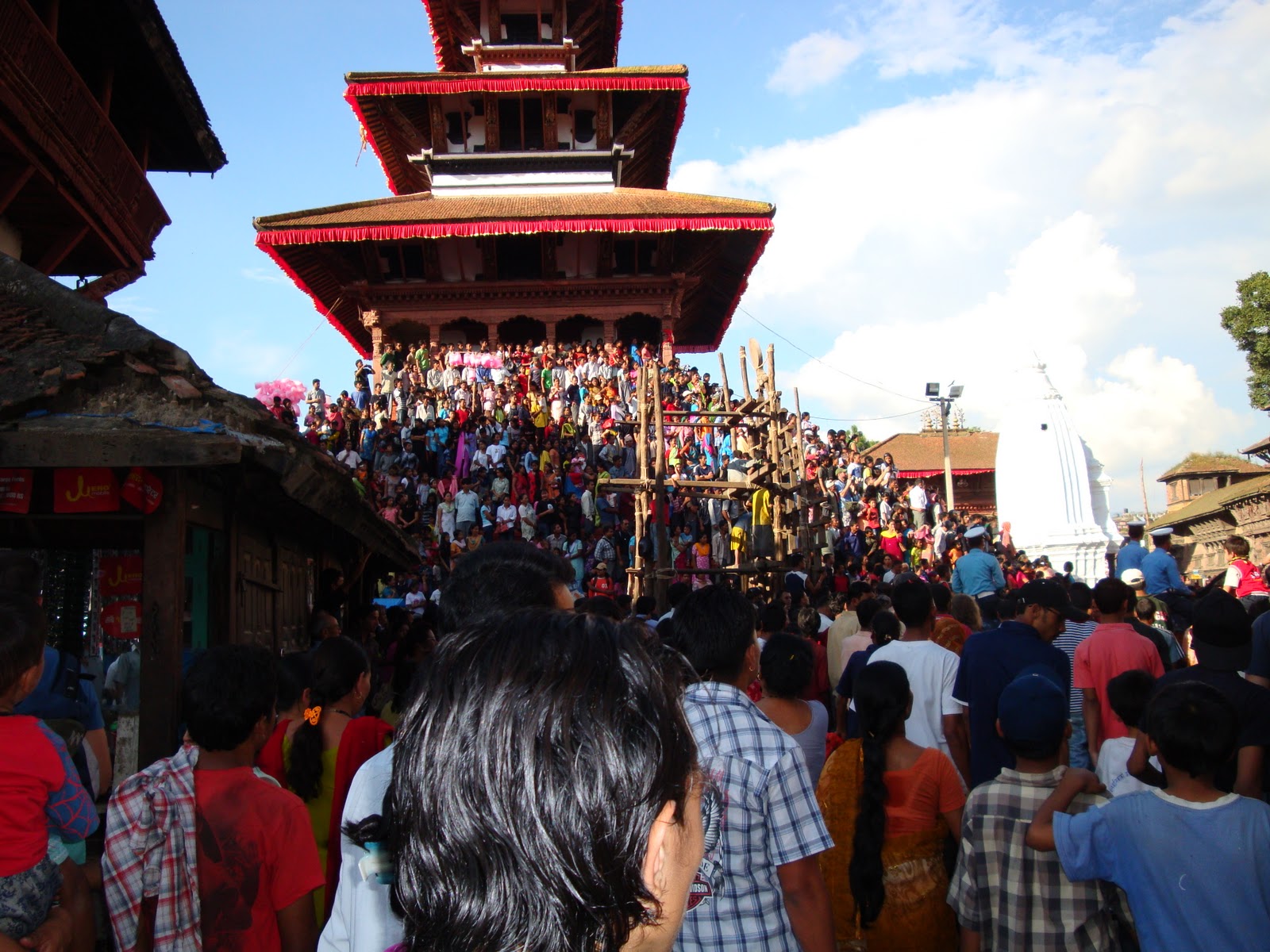
Even more amazing, the Director of the Fulbright Commission found us seats at Jaisidewal, a perfect platform high above the chaos from which to view everything. On the way there, our path was briefly blocked by police in riot gear as the Prime Minister's car drove by. Jaisidewal is one of the pyramid-like temples that surround Durbar Square:


From there I was able to see the order of events. First came a procession of demon dancers, who proceeded to the stage where they performed for the rest of the evening.


Laid out in the center of a wide street was the samaibaji, offerings of food for the Elephant, for Ganesh and Bhairab and for the Kumari.


Then the Elephant showed up. He was given some food, and then he proceeded to dance around and through and against the crowd.


After the Elephant Dance, there were some military parades and some more demon dancers. Then a small wooden chariot appeared, pulled by dozens of volunteers with linked arms. This was the chariot of the child incarnate of Ganesh:


After it left came an identical small wooden chariot. This was the chariot of the child incarnate of Bhairab:


I hope I didn't accidentally reverse Bhairab and Ganesh


As you'd expect, many of the devotees of the child incarnate of Ganesh are also huge Led Zeppelin fans.

As each chariot passed, a large white fabric would be passed from the pile of samaibaji to the chariot and offerings would be passed into the hands of the children.
As it grew dark, the Lakhe appeared. He was just as I had remembered him.


Hold still so I can take your picture!

And immediately following, to the jubilation of the crowd, came the giant golden chariot of the Kumari:


She was smaller and cuter than I remember, and she seemed to be chewing on something the whole time.

The chariot disappeared behind the side of Jaisidewal just as dusk turned to darkness. The crowd lingered, but our Nepali teacher guided us through the twisting maze of darkening back alleys that she knew by heart and we soon found our way to the bus park. And so that was Indra Jatra 2010.

The Stone Inscription of King Pratap Malla

I thought this was a good picture for the header of my blog:


It is a stone inscription set into the Royal Palace by King Pratap Malla in 1664. It is dedicated to the Goddess Kali and written in 15 different languages, including French and English (to me it looks like the words "New" "Inter" and "L'Hivert"). According to legend, if any person is able to read all 15 languages milk will flow out of the wall from a spout nearby.

And by legend I mean random untrustworthy websites and Nepal guidebooks. If anybody can find any better information on the stone inscription, like the names of the languages or the content of the inscription, I would appreciate it.

Monday, October 11, 2010

Chapagaon

I moved out of the giant house in Kathmandu last week. Two nights before I left, I met the American girl whose presence had caused the family to hide me away. The meeting was actually pretty anticlimactic. I had expected a scene. I was just talking with the family in a room at night and she came down because she heard English. They said that I was a friend of one of their cousins and that I was visiting and staying the night (which was all technically true). We talked a little bit, but then the next day everything went back to the way it had been. I never saw her again.

I moved back into the Lazimpat apartment for a few days. We had some training. Both of our Nepali teachers had been simultaneously hit by motorcycles while walking back from the Fulbright Commission. One was injured so badly that she couldn't move from her house and we had to visit her for Nepali class. She is having her leg x-rayed today. It was a bad deal - people need to build some sidewalks around here.

And then the day came that we moved into our villages. I knew where I was going to be placed before anyone else did because I had said that I wanted to teach in a school with a population of nonnative Nepali speakers - I wanted to experience a school dynamic where English is a second language for some and a third language for others. I was told that Chapagaon has a large Newari population, so I said that I wanted to go there. Also, it is near where my friend from Pitzer Nepal is living, and I heard that there is a German NGO nearby.

Chapagaon may be the most remote location and it is the furthest from the other ETAs, in the foothills at the edge of the valley. After dropping off two other ETAs, the bus drove me past Newari storefronts, a bus park and some temples of Bhairab, and then we turned out of the village and down a steep hill into the jungle. Apparently I will actually be teaching in a tiny, tiny village called Bistagaon about 20 minutes walk from Chapagaon. My house is in a nearby village called Boharatar, and it looks like this:


It is a traditional house with mud floors and tiny doorways that I hit my head on and a tiny wooden staircase to my small room with no shelves or cupboards. I love it. There's no indoor plumbing but interestingly they do have a dial-up internet connection through a phone line (the internet is fast enough to read mail but not usually fast enough to write it). The family, which consists of a grandfather, grandmother, son and wife, two grandsons and a granddaughter, buys none of their vegetables. They grow rice, corn, chili peppers, cauliflower, tomatoes, potatoes, spinach, bitter gourd, wildflowers, and probably some other things I don't know about. They only have to buy some of their rice and things like spices and condiments. There are two cows and a goat, but I believe the goat is not long for this world. The great festival Dashain is coming up and something's gotta get sacrificed. There is also a lazy and friendly dog whose front tooth is broken so that it always looks like he is showing his fangs while he is whining happily and wagging his tail.

My host father is also the Head Teacher (principal) of the school where I am teaching. I have to admit this worries me a little, but he seems like a jovial sort. I was completely overwhelmed by my reception at the school. The entire school lined up at the entrance and cheered as the principal placed tikka on my forehead and placed an honorary topi on my head (they never make them quite large enough for me). I walked between two lines of clapping high schoolers as they gave me flowers and well wishes, and then we went to the teacher's lounge where everyone went around and made speeches about how great this opportunity is for all of us. It was humbling and terrifying.


The tall one in the middle: Me.
To my left is the school's Head Teacher and my very gracious host.
To my right is my NELTA contact person.

I spent the next week observing classes. Several times I was asked to give lessons or to teach but I insisted on getting to know how things are done at the school. So this is the school:


Shree Udaya Kharka Madhyamik Vidyalaya: Rising Field Secondary School of Bistagaon, Chapagaon VDC, Lalitpur. Established in BS 2017 (AD 1960). Approximately 400 students from Nursery up to 10th grade. From a week of observation it appears that there are about as many male students as female students. There are many students whose first language is Nepali, many whose first language is Newari, many whose first language is Tamang, and a few who grow up speaking Nagarkoti. English is taught from the Nursery level, although many teachers have told me that English fluency among students is one of the biggest challenges they face.

The school seems to enjoy an unusual amount of support from outside the country. In addition to my presence as a Fulbrighter, they have a computer lab donated by an American organization, some construction has come from German funding, and the Japanese have had a hand in cultural programs.

So the current plan is that I will have a schedule teaching different classes with my counterpart teacher at different times during the week, focusing on grades 5,6,7,8, and 9. At grade 10 there is a nationwide standardized test called the School Leaving Certificate (SLC) without which a student cannot go on to higher study. The test carries questions lifted directly from the texts, so it is more important at grade 10 to learn from somebody who knows the textbook well.

My counterpart teacher is a very good teacher, which is a little intimidating. All the training I have had has been about providing context to the textbooks, including games and real world experiences and realia and that sort of thing. The training came from people who had a hand in creating the textbooks, but in my observations and in theirs the teachers often do not have the resources to provide that sort of context. My counterpart teacher is very resourceful, though, and already uses a lot of these techniques. I hope that I will be able to contribute to his resourcefulness when I start teaching...

Which unfortunately won't be for a couple weeks. Friday was the first day of Dashain, the biggest holiday in Nepal. The school is closed for fifteen days. At least I will have a few days to celebrate Dashain in this new village. Right now I'm in Kathmandu for a little more training and reflection on our observations.

Oh, one more thing:

Hey James, are you jealous?

When I mentioned that I played the piano, they told me that the school had a collection of "mouth pianos." Apparently the Japanese had donated ten melodicas to their music department but not many people know how to play one. I'm thinking of starting a Melodica Club or a Traveling Nepali High School Melodica Orchestra & Revue or something...

Well, congratulations on making it to the end of this post. Happy Vijaya Dashami!

Tuesday, October 5, 2010

The Mythology of Indra Jatra and the Living Goddess

So Lord Indra took corporeal form and came down from the heavens on his elephant to visit Old Kathmandu. He tied the elephant up at Indra Chowk.

Right here.

He walked out of the city to the flower fields and picked a flower, but was discovered by an angry farmer who tied him up and rolled him into town on a cart. The elephant angrily broke his restraints and crashed around Kathmandu, but was unable to find his master. After eight days Indra revealed himself to be a god in front of the townspeople and they let him go.


Durbar Square.

And that is why in late September the people of Kathmandu celebrate Indra Jatra, the festival of Indra.
Indra brings the rains of the monsoon season, and only after Indra Jatra are children given permission to fly kites in the skies above Kathmandu; this is a sign to Indra that the rains are no longer needed.


Newari Storefront Woodwork.
Over 500 years ago the Malla Kings ruled the three kingdoms of Kathmandu Valley. The ruler of Old Kathmandu was renowned as a wise and great king. However, he had a secret. At night he would leave his house and make his way into an empty dwelling where he would play games of chance with the beautiful and powerful goddess Taleju. She personally would advise him on matters of state on the condition that he and he alone would be allowed to see her and sit in her company.
But the queen became suspicious of the king's late night meanderings and decided to follow him. Hearing a feminine voice behind the door, she angrily threw it open. The beautiful goddess instantly vanished and never returned.


Taleju's Temple.

At least, not directly. Taleju agreed to spiritually inhabit the body of a young girl chosen from a few honored families of the Newari priestly class. Until the day that she first sheds blood, either through injury or menstruation, the chosen young girl is revered as a Living Goddess. She is sheltered and kept hidden away from the public. Except on Indra Jatra.
On Indra Jatra the Kumari rides through the thronged streets of Kathmandu into Durbar Square in a wooden chariot pulled by a dozen or so people with a rope. In front of her, in smaller chariots, ride two young boys of lesser stature that represent the gods Bhairab and Ganesh. The Lakhe, a man dressed in a large mask and said to be possessed by the spirit of a revered demon, dances before the chariot. Other demon dancers perform on various stages. Men possessed of the spirit of Indra's elephant dress up in an elephant costume and dance chaotically through the crowded streets, snatching up dropped items and occasionally knocking over stragglers.

This is the chariot of the Kumari on display the day before.


In the 1760s, when the Nepali-speaking king Prithvi Narayan Shah swept into Kathmandu Valley in his campaign to conquer and unify modern Nepal, he and his people replaced the resident Newaris as the upper caste elite. Yet he bowed down to the young lower caste Kumari and continued the ancient tradition of publicly receiving a blessing from her on Indra Jatra. And each subsequent king publicly received a blessing from the Kumari on Indra Jatra until 2008, when the monarchy was formally abolished.

These are the chariots of Bhairab and Ganesh.

Sunday, October 3, 2010

Prem Baad

What is Prem Baad? Who is Vikas Ananda?

This little bit of graffiti can be found in literally thousands of places around Kathmandu. On practically every wall, every post, every sidewalk throughout the city you can spot this odd twirly question mark and the words "Prem Baad." Just now I walked out of the cafe where I am writing to see how long it would take me to spot it - I found one on a post less than half a block away.

And yet whenever I point it out to a Nepali and ask what it means, they invariably tell me that they have never noticed it before. I find that difficult to believe; the symbol is found in almost every corner of the city and they have been around at least since the last time I was in Nepal two years ago. It has been a mystery to me for a long time.

Prem Baad means "Loveism." (Baad is used with another word to suggest an ideology, e.g. samaaj baad -> society ism = Socialism or mao baad -> Maoism). The twirly question mark appears to be a Buddhist symbol like those used on the magnificent stupas and monuments throughout the city:


This was taken at Swoyambhu. Look closely below the eyes.

One of my Nepali professors told me that "Loveism" is the philosophy of Vikas Ananda, a very popular spiritual guru in the city. These bits of graffiti sprang up as a protest against violence and political divisiveness in Nepal. So, mystery solved?

Unfortunately, nobody can tell me very much about Vikas Ananda and these followers of his that put up graffiti all over the city. I have yet to find anyone here who knows very much about it or any mention of either Prem Baad or Vikas Ananda on the Internet. I would appreciate if someone who has a more secure Internet connection could help me by finding more information (my settings have been changed so that anyone can leave comments now).

Part of the problem probably comes from the ambiguities of Romanized Nepali: Bad could be spelled Baad, Wad, or Waad. Vikas could be Vikaas, Vikash, Vikaash, Bikas, Bikaas, Bikash, Bikaash, Bhikas, Bhikaas, Bhikash, or Bhikaash.